


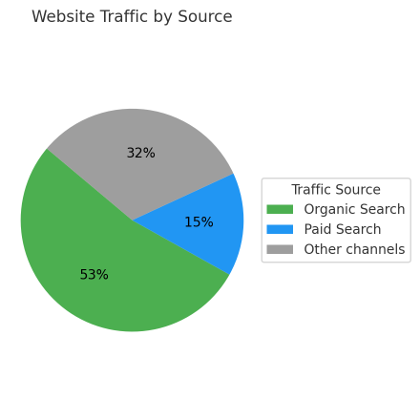
For early-stage founders, “getting found” isn’t optional—it’s oxygen. Organic search alone drives about 53% of trackable website traffic, making Google the most reliable place to capture demand beyond social spikes or referral luck.
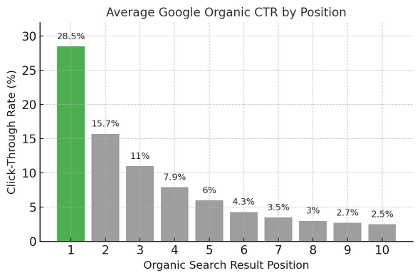
 Meanwhile, the #1 organic result typically earns about 28.5% CTR, underscoring how much visibility compounds at the top of the SERP.
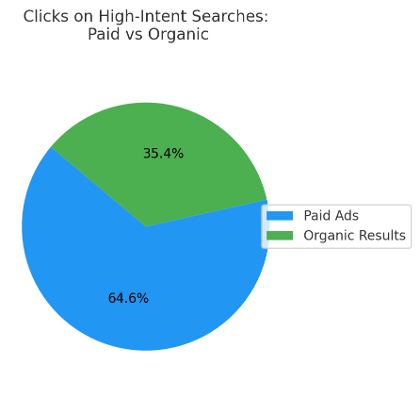
At the same time, high-intent searches (the “buy now / compare pricing” kind) often go to paid ads. Historic benchmark data shows ~64.6% of clicks on such queries hit sponsored results. For startups, that means PPC can unlock an immediate pipeline while SEO builds durable momentum.
This guide teaches how to combine PPC (Google Ads) and SEO (Search Engine Optimization) to generate leads today and lower acquisition costs over time. We’ll cover quick-win tactics, long-game compounding moves, and two real-world case studies you can borrow from now.
Why start with both PPC and SEO?
-
Search is where intent lives. Organic + paid search together account for roughly two-thirds of trackable traffic in many analyses. You want presence in both lanes.
-
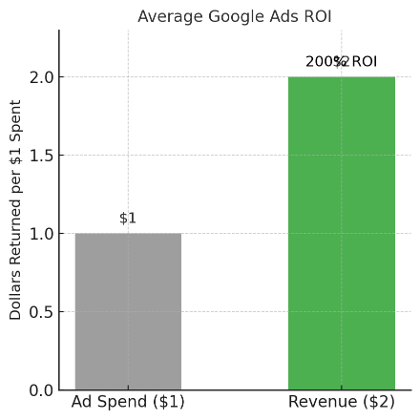
Paid = speed. Benchmarks consistently peg Google Ads ROI around 200% on average (i.e., $2 revenue per $1 spent) when campaigns are correctly optimized. Exact figures vary by industry, but the point stands: PPC can work fast.
-
Organic = staying power. The compounding effect of ranking well on high-intent and informational queries is what eventually drops your blended CPL. Position #1 CTR ~28.5% is your reminder.
Relevant keywords used throughout: lead generation, Google Ads, PPC, SEO, early-stage startups, B2B SaaS, keyword research, search intent, long-tail keywords, Quality Score, CTR, CPC, CPA, conversion rate optimization, landing page optimization, remarketing, inbound marketing, content marketing, backlink building.
PPC for quick wins: how to structure your first 60 days
Goal: Immediate visibility on high-intent keywords while proving a sustainable CPL/CPA.
-
Tight keyword scope (weeks 1–2).
Start with exact/phrase match terms that scream intent (e.g., “best [category] software,” “pricing,” “for startups”). Add negatives early to cut waste. -
Message–match your landing pages (weeks 1–3).
Ensure 1:1 alignment between ad promise and page headline, bullets, and CTA to lift Quality Score and reduce CPC. Track conversion actions (trial, demo, lead form). Benchmarks show search conversion rates ≈ of 3.75% across industries—use this as a sanity check while you optimize. -
Bid smart, measure smarter (weeks 2–6).
Start with Maximize Conversions (with proper conversion tracking), then migrate to tCPA / tROAS once you’ve got enough data. Keep a weekly ritual:-
Pause expensive, non-converting keywords.
-
Split-test ad headlines (benefit vs. feature), and tighten sitelinks/callouts.
-
Refine audiences (geo, device, time-of-day) to your best-converting slices.
Well-run programs often land near ~200% ROI; your mileage will vary, but the levers are controllable.
-
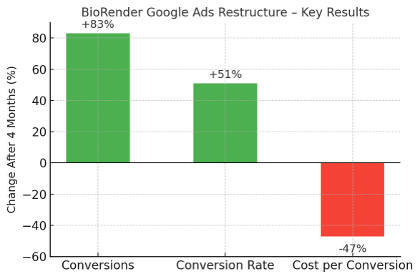
PPC case study: BioRender’s 4-month surge
What happened: BioRender (B2B SaaS) reorganized Google Ads, tightened targeting, and improved relevance.
Results in 4 months:
-
+83% conversions
-
+51% conversion rate
-
–47% cost per conversion
What to emulate: rigorous account audit, structured campaigns, and ongoing search-query pruning.
Chart-ready datapoints (PPC): +83% conversions, +51% CVR, –47% CPC/CPA (BioRender); 3.75% avg search CVR benchmark; ~200% average ROI benchmark.
SEO for the long game: compounding trust and lower CPL
Goal: Build topical authority, rank for decision-stage queries, and attract top-/mid-funnel traffic that nurtures into the pipeline.
-
Map search intent to the funnel.
-
TOFU (informational): “How to choose a [category] tool”; “KPIs for [audience]”
-
MOFU (consideration): “Best [category] tools for startups,” “alternatives to [competitor]”
-
BOFU (transactional): “[Your product] pricing,” “[category] demo”
Prioritize long-tail keywords (lower difficulty, higher specificity) to earn early wins.
-
-
Publish depth and consistency.
Aim weekly for:-
1 diagnostic guide (3–5 problems your ICP feels + solutions)
-
1 comparison/alternatives page (honest, criteria-based)
-
1 bottom-funnel landing page (category + use case)
Plus quarterly original data (surveys, benchmarks) to attract backlinks.
-
-
Technical basics that move the needle.
Core Web Vitals, fast LCP, schema on key pages, internal links from high-authority posts to money pages. Remember: visibility compounds #1 organic averages ~28.5% CTR across mixed SERPs, and organic typically contributes ~53% of traffic over time.SEO case study: College Raptor’s content engine
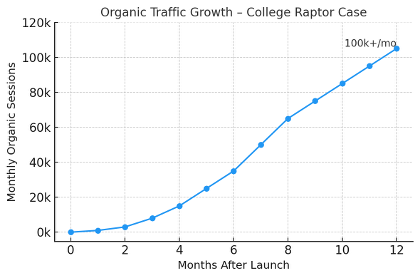
What happened: A content-led SEO strategy—covering evergreen questions, linkable resources, and intent-mapped articles.
Results: From 0 to 100,000+ organic sessions/month in ~1 year (over 1M visitors in that first year). Takeaway: consistent publishing + link acquisition + solid topic architecture can 10× organic acquisition inside 12–18 months. OptimistChart-ready datapoints (SEO): 100k+/mo organic sessions in ~12 months; 1M+ first-year visitors (College Raptor); organic share ≈ 53%; position-1 CTR ≈ 28.5%.
How PPC and SEO strengthen each other
-
PPC reveals winners fast. Use high-converting PPC keywords and ad copy to inform SEO topics and page titles. If “best [category] for remote teams” converts paid, build the organic guide and a category page for that exact phrase.
-
Own the SERP twice. When you rank organically and run an ad, total clicks typically rise due to double presence and added credibility on the page (especially for competitive terms).
-
Remarketing closes the loop. Use paid remarketing to re-engage organic visitors who bounced, show them a case study or pricing ad, and pull them down-funnel.
-
Budget shifts over time. As organic ranks solidify, reallocate some ad spend to new tests (new geos, segments) while keeping paid coverage on the most competitive / bottom-funnel terms.
Metrics that matter (and how to judge them)
-
CTR (Click-Through Rate): Are we relevant? (Paid & Organic; organic CTR benchmark for #1 ≈ 28.5%.)
-
CPC (Cost Per Click): Are we buying efficiently? (Paid; optimize Quality Score via message-matched pages.)
-
CVR (Conversion Rate): Are clicks turning into leads? (Paid benchmark: ~3.75% across industries; your target may be higher.)
-
CPA / CPL: Are we profitable yet? Use PPC while SEO matures; shift budget as blended CPL falls.
-
ROI / ROAS: Keep sight of revenue impact; healthy search programs commonly report ~200% ROI when dialed in.
30-day starter plan (you can apply this immediately)
-
Week 1: Implement conversion tracking, define one primary KPI (demo, trial). Launch a tight PPC set (10–20 high-intent keywords), write 2 landing pages that match ad groups 1:1.
-
Week 2: Publish two SEO assets (one TOFU guide, one BOFU comparison page). Add internal links from blog → landing pages.
-
Week 3: Audit search-term reports; add negatives; A/B test headlines; launch remarketing to site abandoners.
-
Week 4: Publish one original data mini-post (even a small survey or aggregated benchmark) to pitch for 2–3 backlinks; update top PPC queries with the winner copy.
Numbers at-a-glance (easy to turn into charts)
-
53% of trackable traffic from organic search (BrightEdge).
-
28.5% avg CTR for #1 organic result (SISTRIX).
-
~64.6% of clicks on high-commercial-intent keywords go to ads (WordStream).
-
~200% average ROI for Google Ads when optimized (WordStream).
-
3.75% average search CVR across industries (WordStream).
-
BioRender PPC case (4 months): +83% conversions, +51% CVR, –47% cost/conv (Upgrow).
-
College Raptor SEO case: 0 → 100k+ organic sessions/month in ~1 year; 1M+ first-year visitors (YesOptimist).
Conclusion (with CTA)
Treat PPC as your sprint and SEO as your marathon. PPC provides immediate deal flow and rapid message testing; SEO compounds authority and slashes your blended CPL over time. The startups that win search don’t choose one—they sequence and integrate both.
Need help setting this up end-to-end?  Book a Free Strategy Call with Van Natter Consulting Group
Van Natter Consulting Group builds balanced search engines for growth: tight PPC, scalable SEO, and analytics you can trust. Let’s map your high-intent keywords, publish with purpose, and put your brand where the buying happens.